Sea lamprey try to avoid the smell of certain chemicals, including the scent of rotting sea lamprey and another compound found in human spit (See it here!). Understanding how sea lamprey react to these chemicals under different conditions allows for managers to try to use these chemicals to help control lamprey populations. Recent work by Di Rocco et al (link) has just shown that temperature and the whether the lamprey was hiding or not. Lampreys in warmer water who were searching for spawning sites were must reactive, while those in cold waters that were hiding did not respond.
Check out this post for more lamprey fleeing from "the smell of death" and to learn more!
Tuesday, March 4, 2014

Saturday, February 15, 2014
Sea lamprey like the smell of little sea lamprey...but not enough to come home
Sea lamprey do not home to natal streams like salmon. In simpler terms, sea lamprey do not seek out the stream from which they were born. Instead they rely on chemical cues to help guide them to a location that will let them reproduce successfully. One of these cues is the smell of larval sea lamprey (ammocoetes) buried within the stream beds. New work suggests that this smell, although it is important in making sure adults examine the stream to determine if they want to enter it to spawn, is not enough to actual make them swim upstream (link).
Thursday, February 13, 2014
Presentation on work from this summer
I recently presented material at the annual New York American Fisheries Society conference! If you would like to see a video describing some of the results from this summer take a peak: https://www.youtube.com/watch?v=vh4isqLdTC0
Feel free to leave a comment and check out some of the other presentations if you have time, there are many more available to view on the NY AFS channel (Link).
Feel free to leave a comment and check out some of the other presentations if you have time, there are many more available to view on the NY AFS channel (Link).
Sunday, September 15, 2013
End of the Summer
Unfortunately all summers must end, and so it is this year as well. We are wrapping up our fieldwork and focusing on the lab component. Below are a number of pictures from this summer that we had not posted yet.
 Above is a damselfly perched on a leaf. Damselflies have four large wings that fold across the back. These are one of the most primitive aquatic insect groups (mayflies and dragonflies being the others). This individual was from Annsville Creek.
 Another species of damselfly. All damselflies hunt on the wing capturing any small insects they can, they often then eat the prey on the wing while looking for another target.

 This is a megalopteran, a different species, and likely a different genus (probably Sialis sp.), than the one we captured at the Black Creek. This is an adult which was out looking for a mate.
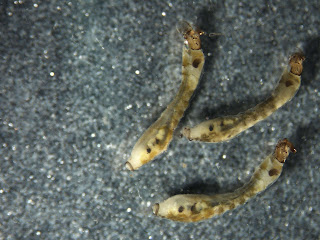 Above are black fly larvae (Simulidae) that we collected during out work. These are the larvae which are filter feeders, and also good indicators of high water quality. They secure themselves with silk threads to the end of rocks and are present in the fastest flowing sections of the water.
 We found lots of lampreys in this stream under I-87. You never know what you maybe driving over top of when you are in the car.
 This is a mummichog (Fundulus heteroclitus) we captured in the Muitzes Kill. This is a male, if his fins were better exposed you would see that they are actually fairly colorful.
 Natural falls located at High Falls, NY. These are the lower of the two falls, with a dam at the top of the highest falls. In the spring time sea lamprey adults are regularly recorded from immediately below these falls.
 An ammocoete from immediately downstream of the falls pictured above. This animal (based on the other animals we found there) was probably 3-5 years old. The nametag it had said "Bob".
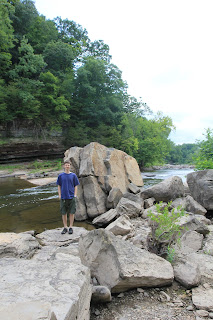 Me standing sheepishly next to a rock at High Falls that was recently relocated by hurricane Sandy. The water level after the hurricane was still another 50 feet higher than me.
 Looking out onto the Hudson River from the Sawkill at Bard College. The green mat is actually an invasive plant (water chestnut, Trapa natans) that has become quite a problem in the Hudson River. However, the scenery is still gorgeous.
I will continue to post on this blog about sea lamprey, although we may now expand our coverage to more than the Hudson River!


This waterfall is a natural falls present on the Kaaterskill Creek outside of Catskill, NY. Sea lampreys are actually able to pass this barrier and spawn upstream.


I will continue to post on this blog about sea lamprey, although we may now expand our coverage to more than the Hudson River!
Monday, August 19, 2013
Return to Lowland Town Park (Cedar Pond Brook Creek)
During this summer I have been working under two grants (one through the Sussman Foundation and the other through the Hudson River Foundation). Both grants are interested in identifying the location of sea lamprey in the Hudson River and the capture of ammocoetes as vouchers for further research. However, the Polgar fellowship also includes a stable isotope component. I will need to write a separate entry to describe stable isotopes for those interested but we returned to Lowland Town Park to collect our samples for that portion of the fellowship. Last time we were in the park (July) we did not see any young of year lamprey (we arrived too soon) but we did find lots of them this time!
 We also collected numerous stable isotope samples for analysis this fall when we return and process them at the lab first. Here is a picture of me returning with a terrestrial soil surface sample which we plan to analyze.
 This creek is generally in very good condition with very complex habitat and large areas for the stream to meander. Streams need to move freely to behave naturally. Water is always eroding and access to flat areas around the river (called the floodplain) allow the water to disapate its energy and erode more naturally. This reduces the problem of flash flooding during storms and helps to create a more natural environment. Although rivers are marked on maps with very clear lines, natural rivers actually move quite often and make new paths for themselves (look on Google Earth to see if a local river looks the same as when you visit it today). Moving property away from the edge of a river and allowing it to snake around is important for healthy streams. Fallen logs, dams from debris, and exposed roots are all normal in natural streams. Notice below in the right of the picture the dried stones with vegetation growing on them. This is actually part of the stream bottom during high flow events, and helps get the water downstream without damaging the forest around it.
 Streams (especially in areas where people have lived for long periods) are often forced into narrow paths that are prone to flooding and large scale erosion. If you own property near a stream consider allowing the edge of the stream to grow wild in as many areas as possible to help improve your stream's health. The lamprey will thank you.
The sites we visited are downstream from a park and we did find some basketballs and beach balls trapped in a log jam. This one was returned to the park in need of air, but otherwise fine. On my back is the unit we use to cause ammocoetes to emerge from the substrate. The paddle is used to control the unit and catch the ammocoetes when they emerge.


The sites we visited are downstream from a park and we did find some basketballs and beach balls trapped in a log jam. This one was returned to the park in need of air, but otherwise fine. On my back is the unit we use to cause ammocoetes to emerge from the substrate. The paddle is used to control the unit and catch the ammocoetes when they emerge.

Friday, August 9, 2013
Catskill Creek
We visited Catskill Creek just outside the town of Catskill, NY to look for lamprey. Sea lamprey are known to spawn in the Catskill, and in June when we visited we saw a lone beaten up adult sea lamprey. Sea lamprey likely spawn there between May-June. If you would like to see sea lamprey spawning you will need a boat to travel up the Catskill to their spawning grounds.
While we were there this time we did not see any adults (as we would expect) but we did find lots of of small lamprey. These small lamprey are young of year (YOY), meaning that they are from this year's spawning.
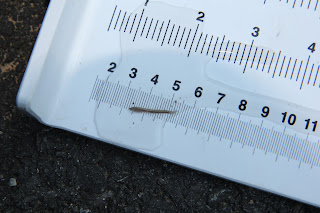
 One of the problems for lamprey researchers is estimating the age of the animals. We know these animals, which are also the smallest are indeed from this year. With that information we can make estimates of the speed at which they are growing and estimate how old an animal like the one below might be.
 The YOY from the Catskill were 16-24 mm long, so we can say that they grow about 20 mm since June. That means they grow about 10 mm per month, so by November, when they stop growing, they should be 40-60 mm long. Which means the larger animal we see above is probably only a year or at most two years old. This is in line with how fast we think ammocoetes grow. Ammocoetes usually take anywhere from 3-7 years to reach maturity.
While we were there this time we did not see any adults (as we would expect) but we did find lots of of small lamprey. These small lamprey are young of year (YOY), meaning that they are from this year's spawning.


Monday, August 5, 2013
Black Creek
Last week, before we returned home when rain threatened, we also visited the Black Creek to look for lamprey. The Black Creek is a beautiful stream whose lower portions are largely protected wooded areas. In the spring visitors can still see alewife runs returning to spawn. Often times other species follow them, and you may also see large stripped bass resting in small pools and feeding on the alewife.
 Sea lamprey have been captured here once before and we initially found conditions which looked favorable to sea lamprey (sandy bottom, clear water, low flow areas, diverse invertebrate community). However, after looking for some time we did not find lamprey of any kind. We did find a dead male blue crab (blue crab are actually common in the Hudson River, even in freshwater areas).
 We also found the largest Hellgrammite I have ever run across. These insects are also called dobonsonflies and spend long periods as aquatic larvae (sometimes more than 3 years) feeding on other aquatic animals before emerging to pupate into the adult. The adults live for less than a month and look for a mate before dying. What you cannot see well in the picture are the gills which are all along the abdomen of this larvae. When removed from the water they cling to the abdomen and are difficult to see. This is a very low diversity group (especially in the Northeast) and this animal could be identified to genus on sight, it was a Corydalus spp.
 Hellgrammites are indicators of high water quality often. Check your local streams by lifting rocks or kick netting to see if you have any. Be careful, although they rarely do, they are capable of a powerful bite which can hurt.


Subscribe to:
Posts (Atom)